Roadmap OS vs Productboard: An Honest Comparison
Quick verdict
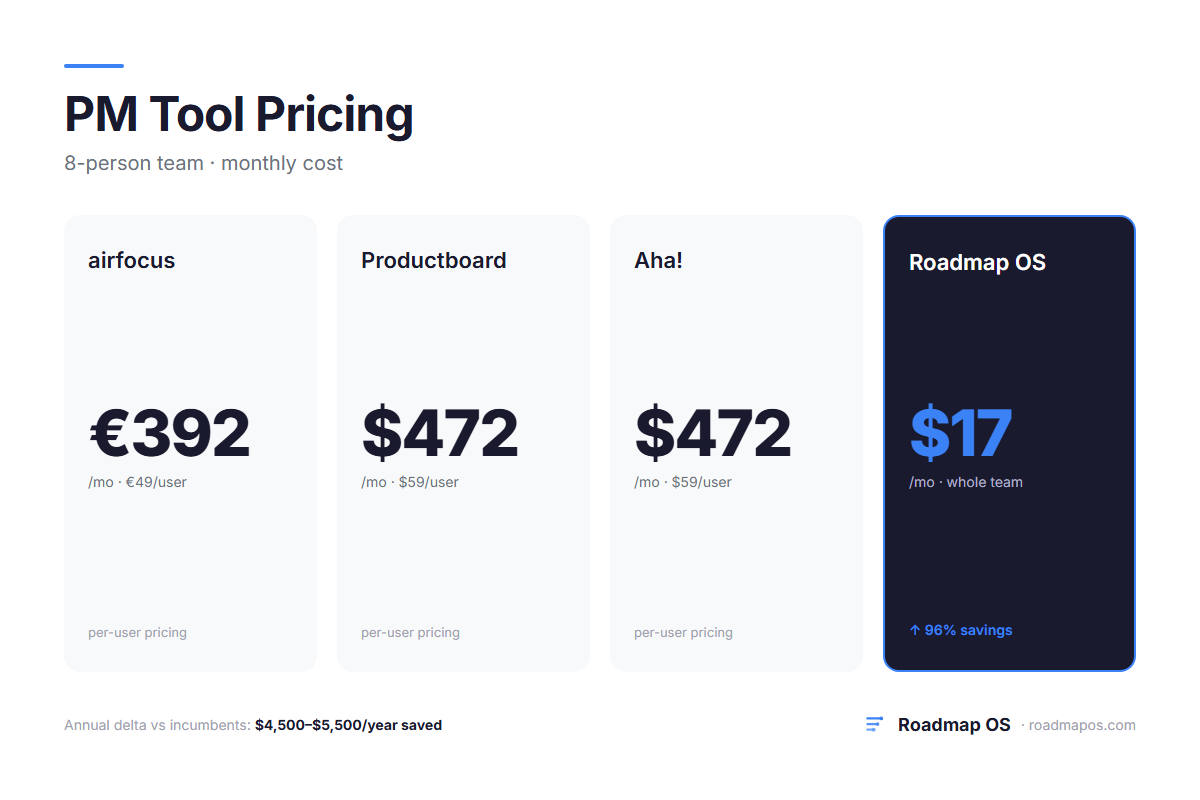
Productboard is the gold-standard tool for customer-feedback-driven roadmapping. If your roadmap is primarily driven by aggregating customer asks, scoring them against strategic objectives, and showing the through-line from feedback to feature, Productboard is genuinely excellent. Roadmap OS is an all-in-one platform that combines roadmap + capacity + plans + products + feedback + GTM in a single tool. It's broader in scope and significantly less expensive, but Productboard's depth on the feedback-to-roadmap workflow is best-in-class. Switch from Productboard to Roadmap OS if:- Your team is paying $59/user/mo and the math doesn't work
- You also need capacity planning, a project planner, or hardware product support
- You have <30 power users on Productboard but everyone else needs read-only access
- You'd rather have one tool instead of three (Productboard + Jira + a capacity tool)
- Your roadmap is heavily driven by customer-feedback aggregation across hundreds of sources
- You have a customer success team actively logging asks
- You need deep enterprise integrations (Salesforce, Zendesk, Intercom — all native)
- Your team is >50 and per-user pricing fits
Feature comparison
| Feature | Roadmap OS | Productboard |
|---|---|---|
| Starting price | $0 (free tier) | No free tier — $20/user/mo (Essentials) |
| Mid tier | $17/mo (whole team) | $59/user/mo (Pro) |
| Top tier | $25/mo Pro | $99/user/mo (Enterprise) |
| Roadmap (Gantt + Kanban) | ✅ | ✅ |
| Now/Next/Later view | ✅ | ✅ Strong |
| Prioritization frameworks | ✅ 6 frameworks | ✅ Custom scoring |
| Capacity planning | ✅ CapacityIQ | ❌ |
| Project planner (WBS) | ✅ Plans module | ❌ |
| Product profiles (lifecycle) | ✅ | ❌ |
| Hardware specs | ✅ | ❌ |
| GTM checklists | ✅ | ❌ |
| Feedback collection | ✅ Public portal + voting | ✅ Best-in-class — multi-source aggregation |
| Customer feedback aggregation | ⏳ Q3 2026 | ✅ From Slack, Salesforce, Zendesk, email, Intercom |
| Insights / linking feedback to features | ✅ Basic | ✅ Deep |
| Release notes | ✅ | ✅ |
| Reports & dashboards | ✅ | ✅ |
| Desktop app | ✅ | ❌ |
| Integrations | 5 (Jira, GitHub, Slack, Asana, Linear) | 10+ (incl. Salesforce, Zendesk, Intercom) |
| AI features | ✅ BYO API key | ✅ AI scribe, copilot |
| API access | ⏳ Q3 2026 | ✅ |
| Public roadmap | ⏳ Q2 2026 | ✅ |
| SOC 2 | Type 1 | Type 2 |
Pricing breakdown
For a team of 12 (1 PM, 6 engineers, 1 designer, 2 customer success, 2 sales):| Plan | Productboard | Roadmap OS |
|---|---|---|
| Cheapest fit | Pro — $59/user × 12 = $708/mo | Standard — $17/mo total team |
| Annual cost | $8,496 | $204 |
For a 30-person team: ~$21,000/year saved.
But — and this matters — that comparison only works if your team would actually use the Productboard depth. If you'd use 60% of Productboard's feature set and pay 100% of the price, you're paying for capability you don't use. The Roadmap OS comparison is "broad utility at a fraction of the price." It's not "feature parity at a fraction of the price." For the customer-feedback-aggregation feature specifically, Productboard wins.
Where Productboard wins
Honest list. They earned it.
1. Customer feedback aggregation
Productboard's killer feature: it ingests feedback from Slack, Salesforce, Zendesk, Intercom, email, and a dozen other sources. It dedupes, links to customers, and shows you which features have the most demand from which customer segments.
If your roadmap is genuinely customer-feedback-driven — meaning your CS team logs hundreds of asks per month, your sales team flags lost-deal reasons, and you score feature requests against revenue impact — Productboard is best-in-class. There's no close second.
Roadmap OS has a feedback portal (public form, voting, status workflow). It's good. It's not Productboard-good for high-volume aggregation across many sources. We're shipping aggregation in Q3 2026, but it'll take 18 months to match Productboard's maturity here.
2. Insights and customer linkage
Productboard lets you trace a feature on the roadmap back to specific customer asks, weighted by customer revenue or strategic importance. That's a deep workflow that requires the underlying data model to support it.
Roadmap OS lets you link feedback items to roadmap initiatives. Simpler, less powerful for high-stakes B2B sales-driven roadmaps.
3. Enterprise polish
Productboard has been at this for 9 years. Their enterprise readiness — SOC 2 Type 2, SSO, audit logs, role-based access control — is mature. Roadmap OS is shipping toward this; we're not there yet.
4. Salesforce + Zendesk integrations
Out of the box. Roadmap OS doesn't have these (Q4 2026 for Salesforce; no firm date for Zendesk).
Where Roadmap OS wins
1. Total scope
Productboard is a roadmap + feedback tool. Roadmap OS is a roadmap + feedback + capacity + plans + products + GTM tool.
If your team is using Productboard + Jira + a spreadsheet for capacity + a separate GTM checklist tool, Roadmap OS replaces all of that.
For small-to-mid teams, "one tool that does the whole job" is more valuable than "the best tool for one slice of the job."
2. Pricing model
Total-team pricing ($17/mo) is fundamentally different from per-user pricing ($59/user/mo). For a 12-person team, the annual delta is ~$8,000.
Per-user pricing also creates a structural problem: you start gatekeeping access. Stakeholders who could give valuable input don't get seats. The roadmap becomes a private artifact.
3. Capacity planning built in
Productboard doesn't do capacity planning. They're focused on the customer-feedback-to-roadmap workflow.
If you ship products (rather than just plan them), you need to know whether your team can deliver. CapacityIQ in Roadmap OS makes capacity visible at the moment of commitment.
4. Plans (project planner) built in
Productboard expects you to use a separate tool for delivery (Jira, Linear, etc.). Roadmap OS includes Plans — a real WBS-style project planner with dependencies, four views, and 200+ templates.
For teams that don't want to maintain both Productboard AND Jira, this is a significant scope advantage.
5. Hardware product support
Productboard is software-only. If you ship hardware (or hardware+software), Roadmap OS's product profiles include BOM, firmware, certifications, units shipped, failure rate. Most PM tools ignore hardware. We don't.
6. Desktop app + offline
Roadmap OS ships a desktop app for Mac/Windows/Linux. Offline-capable. Productboard is web-only.
Who should pick which?
Pick Productboard if:
- Customer feedback aggregation is the #1 driver of your roadmap
- You have a customer success team logging asks at scale (>100/month)
- Your sales team needs to tag feature requests to opportunities
- You can absorb $59/user/mo for everyone who needs access
- You don't need capacity planning or project planning in the same tool
- Enterprise readiness (SOC 2 Type 2, SSO, RBAC) is required
Pick Roadmap OS if:
- You want one tool that handles roadmap + capacity + plans + products + feedback + GTM
- You're a small-to-mid team (5-50 people) that can't justify per-user pricing
- You ship hardware
- You'd benefit from a desktop app or offline capability
- You're in an emerging market
- Capacity planning is a real workflow concern
- You'd rather have founder support than enterprise procurement processes
How to migrate from Productboard
- Export your Productboard data (CSV export per board).
- Sign up for Roadmap OS (free tier).
- Import via Roadmap OS import wizard (we built mappings for Productboard's common field structure).
- Map insights to feedback items. Productboard's "Insights" become items in the Roadmap OS Feedback Portal. Voting and status workflow ports cleanly.
- Re-link initiatives to feedback. This is manual for high-volume teams. Plan a few hours.
- Connect Jira / GitHub / Slack for two-way sync (5 min each).
- Cancel Productboard at end of billing cycle.
For teams with heavy customer-feedback-aggregation workflows: be honest with yourself before migrating. If you have 5,000+ insights tagged to specific customers, the migration cost may not justify the savings. Productboard genuinely shines here.
For teams that have <500 feedback items and would benefit from the broader scope: migration is straightforward.
What we'll fix in the next 6 months
Honest roadmap:
- ✅ Customer feedback aggregation from Slack/email — Q3 2026
- ✅ Public roadmap embed — Q2 2026
- ✅ Salesforce integration — Q4 2026
- ✅ Zendesk integration — Q1 2027
- ✅ Insights with customer linking — Q4 2026
- ✅ SOC 2 Type 2 — Q4 2026
- ✅ Public REST API — Q3 2026
If feedback aggregation depth would tip you toward switching, join the waitlist and we'll email when each ships.
Bottom line
Productboard is the right answer for customer-feedback-driven mid-market product teams that have the budget for per-user pricing.
Roadmap OS is the right answer for small-to-mid teams who want one tool instead of three, especially teams in emerging markets or shipping hardware.
If your roadmap is primarily driven by deep customer-feedback aggregation across many sources, Productboard wins on capability today. If your roadmap is driven by a mix of customer feedback + capacity + delivery + GTM, Roadmap OS wins on scope.
Either way: pick the tool that matches the actual job your team does. Don't pay for capability you don't use.
Try Roadmap OS free →Screenshot references
assets/screenshots/comparisons/productboard-vs-roadmapos-roadmap.png— Roadmap views compared.assets/screenshots/comparisons/productboard-vs-roadmapos-feedback.png— Feedback collection compared.assets/screenshots/comparisons/pricing-comparison-12people.png— Cost comparison for 12-person team.assets/screenshots/comparisons/feature-coverage-radar.png— Radar chart showing feature coverage across the two tools.
Roadmap OS is used by product managers and their cross-functional partners — engineering, design, GTM, customer success — to keep roadmaps, capacity, KPIs and launches in one shared surface. Every initiative links to the people responsible for it; every change is visible to the team that needs to act on it.
Try Roadmap OS
Roadmaps, G2M, KPIs, capacity, AI artifacts — all in one app. From $17/month.